



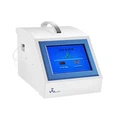
Bubble point: the minimum pressure required for the gas to extrude from the largest membrane pore in the fully wetted porous membrane and form a continuous, stable or large amount of gas flow.
The air flow passes through the hole of the wet filter membrane under high pressure, and the liquid is squeezed out of the larger filter hole, allowing the "large air flow" to pass through

Bubble point is one kind of non-destructive test method which is based on surface tension existing in holes of filter membrane because of the liquid and theory of capillaries pulsation phenomena. It is the most important method to test whether the filter membrane is intact or not, and meets the requirement.
Bubble point test is a non-destructive testing method,which principle is surface tension and capillary hole phenomenon exists in liquid in the filter membrane pores; it meet the requirements and is a important method to test the filter integrity.
When the filter is completely and fully soaked, the gas in gas phase will push out the liquid adsorbed or sealed in capillary holes while overcoming a certain of liquid surface tension, wherein the relational expression of the tension to the physical properties of capillary holes, the aperture is in inverse proportional to the pressure for the generation of the first bubble while passing through the compressed air and is in proportional to the pressure value for passing through the maximum pore canal, which is known as the bubble point of the membrane. Thus, the maximum aperture value of flat filter membranes and the membranes with a column-shaped filter element can be analyzed.